
Thomas W. Jones, Mastering Genealogical Documentation, (Arlington, Virginia: National Genealogical Society, 2017.) Softbound available from the publisher’s website www.ngsgenealogy.org.
Kindle format at Amazon here: https://www.amazon.com/Mastering-Genealogical-Documentation-Thomas-Jones/dp/B0743HCD4T
Hilary Gadsby
Chapter 1
“The Purpose and Nature of Genealogical Documentation”
As a study group panelist I have been asked to write about a part of the chapter that speaks to me.
Why do we need to document what we do?
We spend many hours searching for the answers. We discover information in various ways. We may find direct answers or have to pull information from several places before we can draw any conclusions.
If all that you record is a conclusion how will anyone know how you reached that conclusion. If you need to look at a record again would you know where to find it?
We often find sources may contradict or provide incomplete information. This may require a rethink of our conclusion.
When the source of information is recorded as fully as possible it can add weight to any discussion that may be included with the conclusion.
The type of source and how it is presented can have a bearing on its reliability.
For example a clear digital image of an original document which was recorded at or close to the time of an event by an official or first hand witness will be a much better source than a smudged microform record which could be a transcript of the original.
Why is it important how we document our research?
Citation helps you understand your source
Citation shows what supports your conclusion
Citation allows for repeat evaluation
Citation prevents accidentally plagiarising
Poor documentation can hide both good and bad research. By providing good documentation any gaps or misinterpretation of the sources can be revealed.
We can better understand whether we will meet the standards expected of competent researchers if we cite what we use.
Citation shows what supports your conclusion
Citation allows for repeat evaluation
Citation prevents accidentally plagiarising
Poor documentation can hide both good and bad research. By providing good documentation any gaps or misinterpretation of the sources can be revealed.
We can better understand whether we will meet the standards expected of competent researchers if we cite what we use.
It may be years before we can reach a conclusion. We need to be able to look back at our research and review before we repeat rather than further our investigations. With experience comes a greater understanding.
My aunt told me that there was a child that died young.
I included this piece of information as an interview with her before she died in 2003 (Being a novice then I forgot to record the exact date and I know I visited more than once). I can document this now but not as well as if I had recorded the date of the interview.
I have entered information here Story on Family Search Family Tree.
Then I searched for more information and found it in a newspaper.
Premature Birth The Hampshire Advertiser August 28 1895 Page 2 Column 6 Paragraph 4
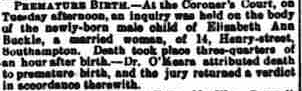
"Premature Birth," 28 August 1895, p. 2, col. 6; digital images, Find My Past (http://www.findmypast.co.uk/ : accessed 9 Sep 2017), British Newspaper Archive. Cit. Date: 9 Sep 2017.
Research is a process and like making a cake if you avoid adding an ingredient (don’t write a citation) the final result may not be what you expect.
Crafting a citation is an important step in communicating your understanding of your source. When we were discussing ESM Quicklessons I compared some certificates in my possession. This illustrates that just citing as a birth, death or marriage certificate was not enough and to understand fully what we have used we need to know more about the qualities of the source.
To take this further look at the second image. I can now compare this to a digital image of the parish register.
The transcription can be found on Find My Past website. But this does not reveal the names of any witness to the event who could be a family member. They do however have digital images as shown below.
Here is Robert Rosling on the Family Search Family Tree.

The transcription can be found on Find My Past website. But this does not reveal the names of any witness to the event who could be a family member. They do however have digital images as shown below.
Here is Robert Rosling on the Family Search Family Tree.

The digital image above actually shows the witnesses and reveals the transcription error made at either the register office in Oakham or when recording in the register held at the register office. I had tried accessing the parish register entry on microfiche held at the Rutland Museum in Oakham but the entry on the microfiche was unreadable.
I have not added any citations to most of the above. The newspaper citation was created using a Legacy template. There are not templates available for every record I want to cite so I need to craft my own and I hope that studying this book will help it become second nature. When we have finished I am going to add citations as footnotes on this entry.
For those that like templates beware I found an error in the Legacy template for the 1911 census for England and Wales which I reported and they said would be fixed. I have not checked whether this has been done yet. So if you find something in a template that does not fit or appears to be missing report it to the software development team.
I have used 2 ways of showing family relationships in this post which one do you find illustrates the best. The diagram or the link to Family Search Family Tree.

