Pages

Showing posts with label Evidentia. Show all posts

Sunday, 18 September 2016

ESM's QuickLessons A DearMYRTLE Genealogy Study Group Lesson 20


Hilary Gadsby


QuickLesson 20: Research Reports for Research Success
Elizabeth Shown Mills, “QuickLesson 20: Research Reports for Research Success," Evidence Explained: Historical Analysis, Citation & Source Usage (https://www.evidenceexplained.com/content/quicklesson-20-research-reports-research-success  :  accessed 17 Sept 2016).

This week we will be discussing the research process.

How do we do our research?

How should we do our research?

Can we improve how we research?

With the growth of the internet how many of us can find ourselves joining in with the quick click genealogy we frequently criticise.

Why do we criticise this way of doing things?

  1. Insufficient preparation
  2. Poorly recorded
  3. Insufficient analysis
So what should we be doing?
Ask yourself these questions.
  1. What do I want to find?
  2. Where should I be doing my research?
  3. How am I going to do the research?
  4. How am I going to record what I find?
  5. How am I going to review what I find?
We can use pen and paper or our computers to assist in these tasks.

We know how to interrogate the databases online and how to enter our results in our software program. There is plenty of information to tell us how to do this either digital or paper.

Do any programs tell us what we need to look for?

Do any programs tell us whether what we find is relevant?

Poor preparation and lack of analysis can lead to hours of wasted research.

How can we know what we need to find if we have not analysed what we already know.

Creating a research plan will be the best thing you do. It will keep you on track. 

If we wish to move on from being just "information gatherers and processors" as ESM states in this lesson we must consider how we approach our work.

This weekend I came across an individual who had been recorded by another researcher in the Wiki Tree website with the maiden name of ROSLING. However this was not the surname for the parents. The link to the 1911 census revealed that she was recorded as their adopted daughter. There was also a link to an army record showing her date of birth in keeping with the census record.
I am researching the surname ROSLING and was interested in knowing where she fitted in the lineage I am constructing.
If I just entered her name in a search would I find anything and how would I know if what I found was relevant.

Experienced researchers will often know exactly where to research and which records may help them find what is available. This does not preclude them from the planning stages but it may reduce the time needed to formulate the plan. Even the experts find themselves stumped occasionally and have to consider alternative strategies. Researching in a new area be it geographical or an unfamiliar set of records may require a different skill set and a whole new learning experience. If we are to complete a thorough research we have to be aware of the resources available. 

Even the best plans may need to be altered in the light of new information. Being prepared and analysing what has been found may alter our focus or the manner in which we carry out our research.
The ability to plan and analyse helps us make better use of the research time.

Complex questions may only be answered if we look at all the information we have and understand what it's telling us. 
Some researchers have found that a program such as Evidentia can help them formulate a plan for these complex problems. By entering each piece of information deciding what it is saying and importantly how reliable that information may be we have a clearer understanding of what we already know. 
The source of any information may be flawed. Awareness of the reliability and being able to resolve conflicting information are analysis skills that may only come threw experience and education. 
Learning from others and sharing personal experience helps each of us become better researchers by improving the knowledge base.

Do we read any accompanying information about a record group that we find online before we enter a name in the search box. If not, why not, surely we need to know if the record will be likely to provide us with the information we need before we search. Would you travel miles to an archive or cemetery without checking that they have what you are looking for first. The same should be true for online records. Finding information and blindly entering it into a database is as boring and pointless as writing lines was as a school punishment. If you want the reward of finding that elusive connection you need to spend time preparing and analysing, formulate a plan, familiarise yourself with what may be available, pinpoint the best way to approach the task and adapt the plan as and when more information is discovered. Not forgetting that negative results do not mean negative evidence, it may be that any record has just not survived.

As we near the end of this study group, we need to pull together all that we have discussed.

I am writing about my research mentioned above on my One Name Study blog. I have not included specific examples this week as I believe that this lesson is more about understanding the process and the importance of doing this well. 
Only we as individuals know whether we have been disciplined in the past.
Hopefully our discussions may have helped at least one of those watching to become researchers rather than gatherer/processors.

Researching when few records or indexes were available online and internet access was expensive.  
I was not aware of research plans so I would go armed with notes that I had made to guide my research. 
Whilst looking for ancestors in the BMD indexes on microfiche I would have a name, range of years, and geographical area. When I found a possible candidate I would record and order a certificate. 
The only way I could access the census was using indexes and then when I could get to the local archive I would have to scroll through the microfilm to find what I wanted. 
The internet has made finding many records easier but has it also created a group of individuals who may believe the adverts that show families building trees using only the online website. 
No website will ever contain all the records and whilst the records support our research they are not the researcher. 
Who pieces together which record is relevant to each individual, who is related to who and how are all these individuals related, it is us as researchers who analyse the information and decide its relevance.

The reporting suggested by Elizabeth Shown Mills may sound quite prescriptive and academic and unless you have an academic background you may switch off at the thought of report writing. However what she is saying is this. 

  1. Compile your findings complete with the information needed to find them again. 
  2. Collect them together in a manner that you are comfortable working with or that fits with your findings.
  3. Summarize what you have found.
  4. Decide whether you have answered your research question.
  5. Decide whether you need to do more research and create a new research plan.
  6. Make a conclusion and write a reasoned report to support this.
Personally I would say that Evidentia will help you do all of these in a guided way.

Finally here is a link to a Google Sheet I created called The Family History Research Process. It contains links to documents that others may find useful. Please add your comments if you think I may have missed something useful that could be added.

Monday, 29 December 2014

Starting Over


 I am going to be joining with a number of like minded genealogists with a common goal.

Our main aim is to construct a family tree that is well documented and that we can leave for others to build upon, rather than something that has to be confirmed because the information required to support the tree has not been recorded or has been poorly documented.

So we are going to set out to ensure that the information we have has been fully evaluated and recorded so that others can follow what we have done and repeat the research if necessary.

In preparing for this I need to define some ground rules. 
This is my current list.
  • Organization of what I have already collected.

I have been trying to do something along this line for the last two years and have already started to reorganize how I store my digital information. I originally started this because I wanted to have my information stored on my computer in the same way I was trying to get my paper records and photographs organized. 
I have been trying to use a colour coding system similar to that described by Mary Hill, who did a Legacy Family Tree Webinar about this in April, the system Mary describes is supported by the Legacy 8 Software program.
  • Collecting information so that I can easily incorporate it into my system.
I have started using Evernote to collect information and I want to put this to more effective use so that it is easier to find digital information that I have collected. I have also used One Note and I need to evaluate whether I want to use this alongside Evernote.
With more use of devices such as my phone and tablet I have also been using Cloud storage systems. Do I use just one or several providers?

  • How do I record what I have found?
What software do I use to record what I have found? 
I have been a long term user of Family Historian. 
Do I stick with this or are there features of other programs that I would find useful? 
I have Family Tree Maker for syncing with my Ancestry trees and have just bought Legacy 8 to try out its citation capabilities and possibly other features.

  • How do I evaluate the information I have found?
I have Evidentia to help me analyse my sources which I intend to put to good use.

  • Where do I start my research?
Do I start by evaluating what I have? Yes

Some of the personal information I will not be able to reproduce, so I need to ensure it is fully and accurately recorded and evaluated.

I shall start as a newbie and gather together the information I have on close family members.

I need to build from a solid base ensuring that each source is a single entity and not a derivative of another source.

I will probably add to this list as the comments of others get me thinking.

As someone has already said I need to start as a beginner, but with the knowledge I have now, rather than the knowledge I had when I was starting my research.

One thing I have already done is set up a folder in my Google Drive for anything I think may help me with my decisions and implementation.


Wednesday, 1 January 2014

New Year Resolution - How I intend to complete my organization task

It is that time of the year again when at the start of a new year we all resolve to do something better, start something new or give something up.

If you have read my introduction or have been following me you know that my passion is genealogy. I am not giving this up!

When I got a new netbook I resolved not to let it and my files get disorganized or duplicated. However as time passed I needed access to items on my old laptop and the duplication or even worse triplication crept in.
I found a program called Easy duplicate finder http://www.easyduplicatefinder.com/ and gave it a try. It worked, up to a point, but some of the problem was due to saving files under slightly different names and file sizes.
How to remove the duplication and organize my files so that I could find what I wanted easily.
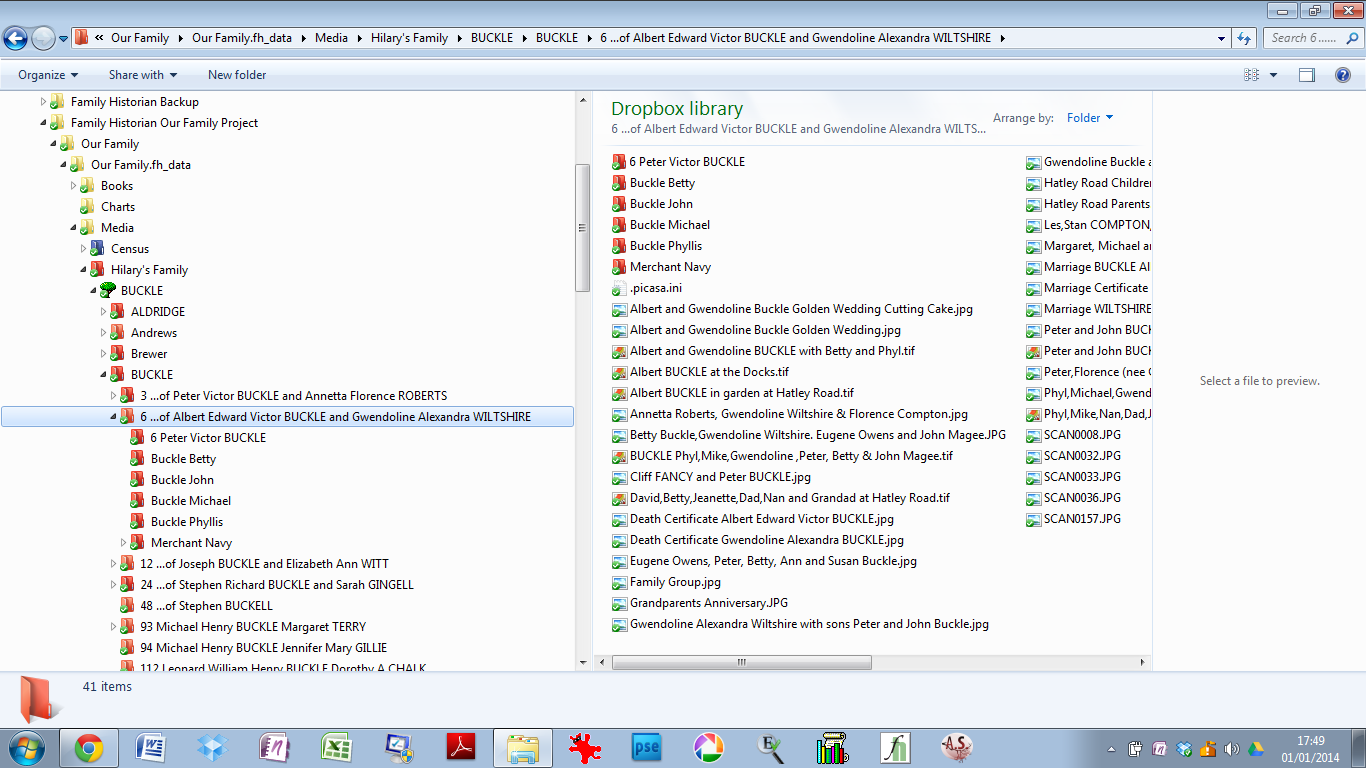
Most of my data is genealogy related and my genealogy program Family Historian http://www.family-historian.co.uk/ allows for everything to be stored in a Project folder. Many items were already in this folder but I was not happy with how it was organized. Most of my photographs are of living individuals but I also have some of gt gt grandparents. I have other digital images and many more left to scan. I have paper files which I also need to organize and wanted to file in a similar manner and had started to rearrange by family.
So how could I organize everything in a consistent manner.
Although some of the more recent photographs will contain members of both my husband’s and my family I decided that organizing using family groups was the best approach. Wedding photographs would be filed under the couple unless they contained an individual alone. Individuals would be filed under their family at the time the photograph was taken so that children would stay with their parents until they married.
Birth and Baptism records are with the parents family whereas marriage and death are with their family at the time of the event. This fits in well for those individuals who married several times and those who never married.
Before subdividing to the families I organize by surname which allows for documents pertaining to more than one family.
I also capitalize the Surnames in the main tree to distinguish them from the other surnames linked into the main tree by marriage.
Each of my son’s grandparents has a different colour assigned to their line. The folders are then coloured using a program called folder marker http://www.foldermarker.com/ .
This program also allowed me to change the Icons for the main folders to a tree.


Finally I discovered a program called Bulk Rename Utility http://www.bulkrenameutility.co.uk which I have started to use to clean up my file naming. This allow you to take several files and rename them in a single action and removes some of the tedium associated with this task.

So my resolution for this year is to complete this task.
Once I have completed this my next task is to reconcile my sources with what I have recorded in Family Historian http://www.family-historian.co.uk/ this I aim to do using Evidentia http://evidentiasoftware.com/.
The developer of Evidentia http://evidentiasoftware.com/ has a new version in beta testing which is due to be released later this year.

My aim is to get this first task completed before the new study group for Mastering Genealogical Proof http://www.ngsgenealogy.org/cs/mastering_genealogical_proof starts as I know I will be busy with this being one of the panelists. This will have a UK slant and will I believe show how the principles of research and analysis in genealogy apply wherever your research and documents are to be found.

I also plan to use Evernote https://evernote.com/ and Onenote http://office.microsoft.com/en-gb/onenote/ to help further my organization skills as I am aware that these are invaluable tools for many genealogists.
I have started using both but have not yet decided exactly how to get the best out of them.

To help me with all this I have signed up for the next Hack Genealogy Boot Camp http://hackgenealogy.com/genealogy-groove-boot-camp-25-january-2014/ and I shall continue to join Legacy Family Tree Webinars http://www.familytreewebinars.com/ and Google + Hangouts http://www.google.com/+/learnmore/hangouts/ to get hints and tips from others.

Thank you for reading my blog and if you have not already seen it please have a look at this new blog http://worldwidegenealogy.blogspot.co.uk/ a collaborative blog which will have contributions from across the globe including yours truly.

Monday, 27 May 2013

 How can Evidentia work for me?                   


Genealogists come in all shapes and sizes but there is one thing that most of us strife to do but very few of us really do well.

What is it that we are so bad at but is really so important and should be the one thing that we would hope to do right?

We are endlessly told how important it is to cite our sources.
Why is this so important?

Well as any experienced researcher will tell you, I wish I had documented my sources so much better when I first started (remembering to date and document what you can remember of a conversation with an older family member, or noting all those negative searches which you repeat a year later even though there is no change in the information).
Most of us have been there and it is so difficult years down the line to be sure what you have or have not done in the past.


Secondly how many of us have entered a source thought we had got as much from it as we could find only to go back years later and realise it held clues which now fit into the bigger picture.
I have 2 marriage certificates with witnesses whose names I did not recognise who later turned out to be members of the family by marriage or illegitimacy.


When I first saw Evidentia being used by other genealogists on a Google+ Hangout I was not sure whether I was ready to embrace using it to enhance my research process.

To see how Evidentia works have a look at the videos on the developers YouTube Channel http://www.youtube.com/channel/UCYKbwE4VYrXm--D2FF7hZ7Q/videos . 
You can also get a 30 day trial to see whether you think the program will work for you. 
Like most programs the first version will not be perfect but the developer is working with users to improve the program so that it can be a great resource for the genealogy community.


The timing in relation to the release of a new book by Thomas Jones http://www.ngsgenealogy.org/cs/mastering_genealogical_proof could not be better.
Evidentia will make you think about how you record your source and about what that source is telling you. It will also help you to decide whether what you have is sufficient to support the facts you have documented.
Analysing the evidence is not new and is something we should all be doing but how many of us are doing it well.

When I document a source I need enough information so that anyone including me can go back and find that information at a future date. Quoting just a url and a date accessed is not enough as tomorrow that url could change the internet is an ever changing source of information and even archives can move so don’t forget to record as much as you can about your source.
In Evidentia you can use templates provided or create your own which can be a great way to remind you what you need to record from those commonly used sources. 

Could these templates help when we are recording our research? 
I know I have got back from a research trip only to find I have forgotten to record something.

Could Evidentia help by producing a template for further research when we have analysed what we already know?


I have not got a copy of Mastering Genealogical Proof as shipping to the UK is likely to be expensive, but if this book deals with the topic of extensive research then it may be that Evidentia will be able to guide users as to how extensive their research needs to be in the future.

I have on my computer a program called Gensmarts which I had hoped would help in this respect but like most programs if what you have recorded is poorly inputted then you do not get meaningful results.


I have high hopes for Evidentia and would 
encourage all serious genealogists to give the program a try. In the absence of anything to replace or update Gedcom this program could be a significant tool.