Pages

Showing posts with label family history. Show all posts

Tuesday, 17 May 2016

ESM's QuickLessons A DearMYRTLE Genealogy Study Group Lesson 7


Hilary Gadsby


QuickLesson 7: Family Lore and Indian Princesses    
Elizabeth Shown Mills, “QuickLesson 7: Family Lore and Indian Princesses,” Evidence Explained: Historical Analysis, Citation & Source Usage (https://www.evidenceexplained.com/content/quicklesson-7-family-lore-and-indian-princesses : accessed 4 May 2016).

This lesson deals with the stories that pass down through the family.
These can either be backed up by the evidence or totally refuted.
Whatever we do we must be sure that the person we have found is the one we want and not just someone with a similar name.
We must also ensure that we look at all credible sources for the time and place we are researching.
If we miss that there is another person with a similar name, or don't consider them in our analysis, we will reduce the credibility of our research.

Stories get passed from one generation to another and as each person passes the oral history it can change and even become a totally different tale.
Oral history should not be dismissed as it can help us to deal with conflicts and changes from one record to another. 
Within my own research I have been told why a living person uses a different name to that recorded on the birth certificate. 
Sometimes social attitudes can be such that the truth is not recorded. During wartime many children were conceived whilst the husband was away and at least some of them will have been registered with the husband's surname. Children born to unmarried girls may have been brought up as a younger sibling by the grandparents.

Many like to believe that they are descendants of nobility or that there is a connection to someone with money. But finding a document does not mean that it is one that relates to your family. Does the information fit with what you already know or are there inconsistencies. Don't wait for someone else to point out your conflicts resolve them, if you can't explain them, highlight them, and think about how you may find out more so that you can resolve them. 


Only this last week I made contact with a third cousin who told me “ Joseph George Robbins was born on the 28th December 1887 in Warminster, Wiltshire. He left Warminster and went to London, became a window cleaner and then got a job as a waiter at The Strand Hotel in London.  He met Edith Fuller who later became his wife. Joseph travelled to New York and got a job as a waiter at the Waldorf Astoria Hotel.  At some point he sent for Edith and she obtained work in the hotel as a “hat check girl”.  They married in New Rachel, USA. Edith became pregnant and was sent back to stay with her mother in England. Violet Georgina Robbins was born on 5th June 1916.Grandfather also worked on ships as a chef and a waiter working for the Orient line and went to Australia on the Orantees and my aunts could remember he visited Fremantle, Adelaide and Brisbane. ”
I am now in the process of confirming the details.

Transcriptions can be easy to find but I always like to confirm things with originals or digital images.
The marriage transcription is on Family Search and here is the citation
New York, New York City Marriage Records, 1829-1940," database, FamilySearch (https://familysearch.org/pal:/MM9.1.1/2435-KDP : accessed 16 May 2016), Joseph Robbins and Edith Fuller, 21 Feb 1913; citing Marriage, Manhattan, New York, New York, United States, New York City Municipal Archives, New York; FHL microfilm 1,613,708

I have also found possible passenger lists for both of them travelling to New York she left on 12 February 1913 and he on the 4 December 1912, however the occupations do not fit with those I have been told about, and the Joseph on another ship leaving Southampton on the 11 March 1914 could be him as he is listed as a waiter. She is possibly following in April 1914 on the Olympic.
Did he go out in 1912 trying to find work and then end up doing something else?

Why did they go back to England after their marriage and return on different ships?

The information that is on the passenger lists is never enough to be certain that you have the correct person(s) particularly with common names.

I have found a record card CR10 which shows his Merchant Navy service on the Orontes this has a photograph of him on the card. (see link to Wikipedia page for SS Orontes)
Another researcher added some family photographs to their Ancestry tree in 2009 and the person on the CR10 matches the person in those photographs.

I have found a website for the Waldorf Astoria and believe there may be records in the New York Archives but I will probably have to wait and see if they become available online. 
I also need to check out the newspapers for any information.

Since Joseph and Edith were both born, and also died, in England, I might never have thought to search elsewhere for their marriage. 
Family stories can be useful but we need to be careful to follow up our hints with good documentation.


Sunday, 3 January 2016

Improving Digital Organisation


Why reorganise? 
  • I have difficulty finding what I am looking for on the computer and search doesn't always help find the file. 
  • I have too many duplicated files. 
  • I need to be able to go through everything systematically. 
  • I need to improve my citations. 
  • All the systems that I have tried in the past have failed.

Considerations
Why have the previous systems not worked? 
  • Lack of consistency. 
  • Too complicated. 
  • Not set myself clear guide as to what goes where. 
  • Merging before checking the content.

What guidelines do I need for the new system to work?
  • The system needs to be simple. 
  • Use shortcuts if possible for file names. 
  • Ensure that the details are contained within the actual file rather than the name. 
  • Use tags.
  • File by provenance to help with citation. 
  • Move everything not in the new system to a holding area. In this area create a folder called To Do for anything that requires more work. 
  • Set realistic goals. Do the easy things first and get them right. It is not a race.

My new system
  • Family folders
    • Family Id Number as in my software program followed by ... then Last name and First name of the couple starting with husband. I will keep indexes. research logs and analysis documents here and anything which is specific to the family.
  • Official Archives
  • Personal Archives
    • Documents
      • Type of Document
    • Photographs
      • Folders labelled by author or if unknown who held them

I will discuss the system in more detail in another post as I am still finalising the details such as where I will put images that I have downloaded from places such as Ancestry and Find My Past.

Wednesday, 1 January 2014

New Year Resolution - How I intend to complete my organization task

It is that time of the year again when at the start of a new year we all resolve to do something better, start something new or give something up.

If you have read my introduction or have been following me you know that my passion is genealogy. I am not giving this up!

When I got a new netbook I resolved not to let it and my files get disorganized or duplicated. However as time passed I needed access to items on my old laptop and the duplication or even worse triplication crept in.
I found a program called Easy duplicate finder http://www.easyduplicatefinder.com/ and gave it a try. It worked, up to a point, but some of the problem was due to saving files under slightly different names and file sizes.
How to remove the duplication and organize my files so that I could find what I wanted easily.
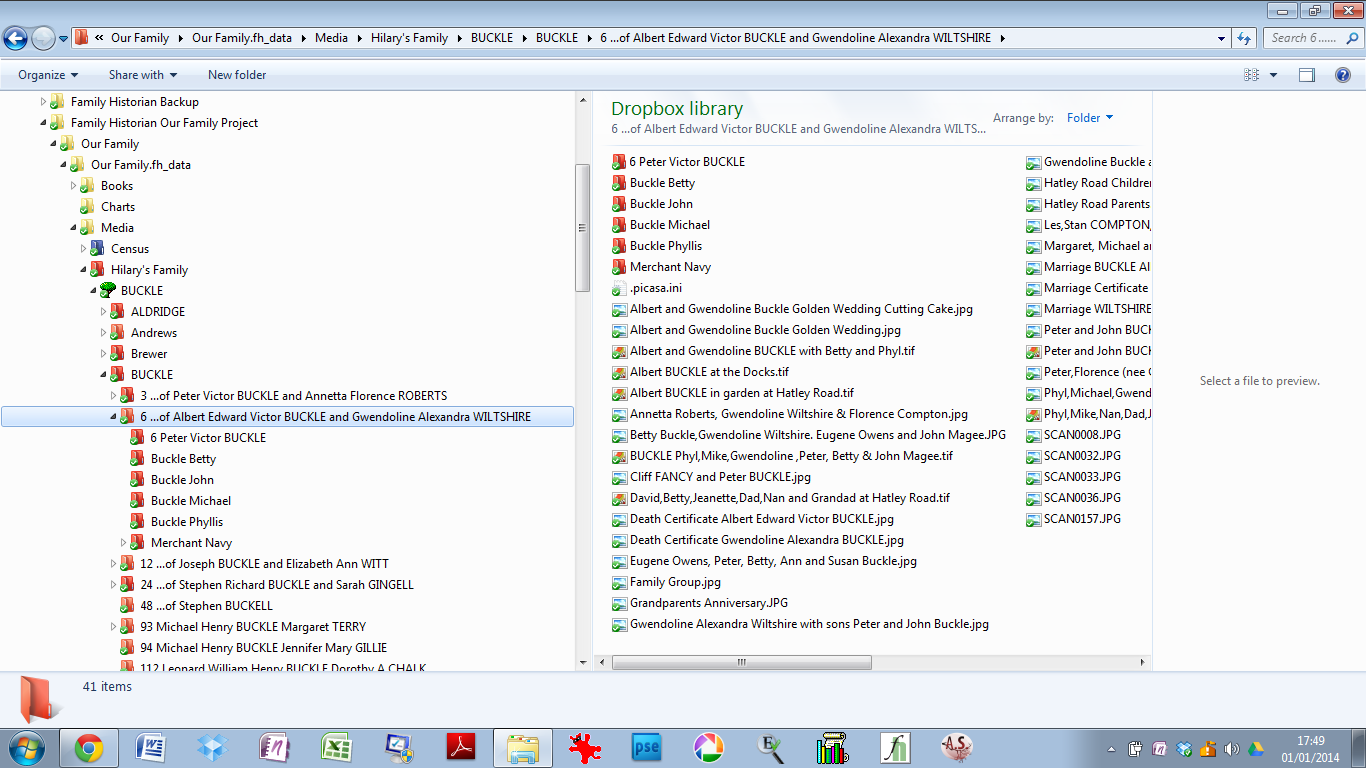
Most of my data is genealogy related and my genealogy program Family Historian http://www.family-historian.co.uk/ allows for everything to be stored in a Project folder. Many items were already in this folder but I was not happy with how it was organized. Most of my photographs are of living individuals but I also have some of gt gt grandparents. I have other digital images and many more left to scan. I have paper files which I also need to organize and wanted to file in a similar manner and had started to rearrange by family.
So how could I organize everything in a consistent manner.
Although some of the more recent photographs will contain members of both my husband’s and my family I decided that organizing using family groups was the best approach. Wedding photographs would be filed under the couple unless they contained an individual alone. Individuals would be filed under their family at the time the photograph was taken so that children would stay with their parents until they married.
Birth and Baptism records are with the parents family whereas marriage and death are with their family at the time of the event. This fits in well for those individuals who married several times and those who never married.
Before subdividing to the families I organize by surname which allows for documents pertaining to more than one family.
I also capitalize the Surnames in the main tree to distinguish them from the other surnames linked into the main tree by marriage.
Each of my son’s grandparents has a different colour assigned to their line. The folders are then coloured using a program called folder marker http://www.foldermarker.com/ .
This program also allowed me to change the Icons for the main folders to a tree.


Finally I discovered a program called Bulk Rename Utility http://www.bulkrenameutility.co.uk which I have started to use to clean up my file naming. This allow you to take several files and rename them in a single action and removes some of the tedium associated with this task.

So my resolution for this year is to complete this task.
Once I have completed this my next task is to reconcile my sources with what I have recorded in Family Historian http://www.family-historian.co.uk/ this I aim to do using Evidentia http://evidentiasoftware.com/.
The developer of Evidentia http://evidentiasoftware.com/ has a new version in beta testing which is due to be released later this year.

My aim is to get this first task completed before the new study group for Mastering Genealogical Proof http://www.ngsgenealogy.org/cs/mastering_genealogical_proof starts as I know I will be busy with this being one of the panelists. This will have a UK slant and will I believe show how the principles of research and analysis in genealogy apply wherever your research and documents are to be found.

I also plan to use Evernote https://evernote.com/ and Onenote http://office.microsoft.com/en-gb/onenote/ to help further my organization skills as I am aware that these are invaluable tools for many genealogists.
I have started using both but have not yet decided exactly how to get the best out of them.

To help me with all this I have signed up for the next Hack Genealogy Boot Camp http://hackgenealogy.com/genealogy-groove-boot-camp-25-january-2014/ and I shall continue to join Legacy Family Tree Webinars http://www.familytreewebinars.com/ and Google + Hangouts http://www.google.com/+/learnmore/hangouts/ to get hints and tips from others.

Thank you for reading my blog and if you have not already seen it please have a look at this new blog http://worldwidegenealogy.blogspot.co.uk/ a collaborative blog which will have contributions from across the globe including yours truly.

Friday, 28 June 2013

Should I Change the Way I do my Genealogy Research?

If you read my previous post on the discussion surrounding a new book called Mastering Genealogical Proof and followed the links you will already have some idea why I have chosen this title.

From the Contents page
Chapter 1 Genealogy’s Standard of Proof
What is genealogy?
Why a genealogical proof standard?
The Genealogical Proof Standard
Modern technologies and genealogical proof
Research and reasoning cycles
Using the GPS

So What have I got from the study group discussion of Mastering Genealogical Proof Chapter 1?

Why do we need to have a set of rules for our research?
We are looking at kinship, relationships of  others to ourselves. We will only have known 2 or 3 generations of our family personally at the most and some of what we know will be hearsay. We look for records to support what we know or have been told but without some guideline how do we know when we have sufficient evidence to support any conclusion we might draw.

Why do we need to set goals?
We need to set goals in order to stay focused.
If we get a negative result this can be as important as a positive one but it is easy to overlook these, leading to repeated fruitless searching.
With historical records there are going to be plenty that are no longer extant.
Those records which may prove to be a "linch pin" in the argument may be the last record we find but if we do not set the right goals we may think we have the evidence we need when it is not conclusive.

Why should we adhere to standards for both our own work and the work of others?
If we want our work to be credible, we need to be sure of our conclusions.
If we fall short in any of the areas covered by the genealogical proof standard then our research can appear worthless.
We should be able to reproduce the work so that we can reassess it if further evidence comes to light.
Conclusions are only as good as the evidence supporting them.

To conclude this post and answer the overriding question of changing the way I do my research I must consider what I have been doing and how I might improve what I am doing.

Like many who live a distance from where their family came from I find limited time for archive research.
We all use the ever expanding online records and these can help us make the most of our research time. However a once a year trip can mean we are keen to gather as many records as possible without truly evaluating their worth.

I aim to organize and evaluate my current records so that when I next visit an archive I will have a much clearer idea of what I want to find and by properly evaluating what I need I may find that I can order records without having to visit in person.

I think Evidentia will allow me to better evaluate what I have and recognize where I have gaps in my research.

Even without the book the discussion is helping me look at what I do and how I do it.

Monday, 27 May 2013

 How can Evidentia work for me?                   


Genealogists come in all shapes and sizes but there is one thing that most of us strife to do but very few of us really do well.

What is it that we are so bad at but is really so important and should be the one thing that we would hope to do right?

We are endlessly told how important it is to cite our sources.
Why is this so important?

Well as any experienced researcher will tell you, I wish I had documented my sources so much better when I first started (remembering to date and document what you can remember of a conversation with an older family member, or noting all those negative searches which you repeat a year later even though there is no change in the information).
Most of us have been there and it is so difficult years down the line to be sure what you have or have not done in the past.


Secondly how many of us have entered a source thought we had got as much from it as we could find only to go back years later and realise it held clues which now fit into the bigger picture.
I have 2 marriage certificates with witnesses whose names I did not recognise who later turned out to be members of the family by marriage or illegitimacy.


When I first saw Evidentia being used by other genealogists on a Google+ Hangout I was not sure whether I was ready to embrace using it to enhance my research process.

To see how Evidentia works have a look at the videos on the developers YouTube Channel http://www.youtube.com/channel/UCYKbwE4VYrXm--D2FF7hZ7Q/videos
You can also get a 30 day trial to see whether you think the program will work for you. 
Like most programs the first version will not be perfect but the developer is working with users to improve the program so that it can be a great resource for the genealogy community.


The timing in relation to the release of a new book by Thomas Jones http://www.ngsgenealogy.org/cs/mastering_genealogical_proof could not be better.
Evidentia will make you think about how you record your source and about what that source is telling you. It will also help you to decide whether what you have is sufficient to support the facts you have documented.
Analysing the evidence is not new and is something we should all be doing but how many of us are doing it well.

When I document a source I need enough information so that anyone including me can go back and find that information at a future date. Quoting just a url and a date accessed is not enough as tomorrow that url could change the internet is an ever changing source of information and even archives can move so don’t forget to record as much as you can about your source.
In Evidentia you can use templates provided or create your own which can be a great way to remind you what you need to record from those commonly used sources. 

Could these templates help when we are recording our research? 
I know I have got back from a research trip only to find I have forgotten to record something.

Could Evidentia help by producing a template for further research when we have analysed what we already know?


I have not got a copy of Mastering Genealogical Proof as shipping to the UK is likely to be expensive, but if this book deals with the topic of extensive research then it may be that Evidentia will be able to guide users as to how extensive their research needs to be in the future.

I have on my computer a program called Gensmarts which I had hoped would help in this respect but like most programs if what you have recorded is poorly inputted then you do not get meaningful results.


I have high hopes for Evidentia and would 
encourage all serious genealogists to give the program a try. In the absence of anything to replace or update Gedcom this program could be a significant tool.

Sunday, 5 May 2013

Are we as Creative as Our Ancestors were ?


This post was inspired by a post made by Thomas Macentee http://bit.ly/157Yhxu .

So how many of us make our own clothes. Very few is the first answer to come to mind. 
I read somewhere that John Lewis is cutting the area it has for fabrics and other handicraft items but that there may be an increased demand for these items in times of austerity. 

When I grew up (being a child of the 60s) girls would have been taught skills such as needlework at school. We were also taught how to cook. Both skills our parents and grandparents would have been expected to learn at home.

My grandmother brought up in an orphanage at a time when many young girls went in to service would have been taught these skills to ensure her employability. Skills she would later use when she had her own family. I well remember the school jumpers or cardigans that she would knit for us when we were children.

Even after the industrial revolution when fabrics were cheaper to produce the everyday working class of this country would make their own clothes as a necessity rather than a matter of choice.
Alongside this change from homemade to shop bought have we also lost other traditions in our culture?
 In the days when most people attended church on a Sunday the working class would have a set of best clothes often referred to as “Sunday Best”. Does anyone have a set of best clothes today?

“Home made” items also bring to mind organizations such as the Women’s Institute (WI) with the label “Jam and Jerusalem” which many turned their back on but may see a resurgence with all the food scares we have seen.

We will never turn the clock back and society has changed and all of us should ensure we record what we remember of our own past as this will be the stories our families want to read, but have we lost something more fundamental when the basic skills of cooking and clothing ourselves have been lost by the majority.

Should making anything from the basic ingredients be a hobby or should we return to the days when we taught children how to cook and sew at home and backed this up with school tuition.

How many of us have children who cannot even cook?
Has the era of ready meals really done our children any favours?
Do we create less than our ancestors?