Pages

Sunday, 16 February 2014

The Occupations of Our Ancestors

 - Should we consider exactly how we view them with 21st century eyes.

This blog post was triggered by a comment Jill Ball made on Google+ about a fellow cruiser’s comment about social media.
She said that a blog post http://butmostlyaboutcats.blogspot.com.au/2014/02/when-new-technologies-emerge.html had reminded her of this comment. This post deals with the reactions of individuals to changes.
Although we all have to cope with changes in our lives many of us adapt to change better than others and some of us actually relish change as a challenge.

I am not going to discuss the management of change so much as how change has influenced our lives and those of our ancestors.

My son has grown up in a world where technology particularly computers are commonplace. Whilst this may not be the norm everywhere most “westernised” and many asian countries are similar. Trying to explain to his generation that we did not have such technology when we were growing up can be difficult. If so much has changed in one generation how can we ever truly put ourselves in the shoes of our ancestors and think and feel as they might have done. To be able to visualize their lives we need to know exactly how they lived and what affected their lives.

Museums, reenactments and newspapers can all play a part in piecing together their story, but can we ever truly see things as they would. Were they the ones who took the changes on board or did they dig their heels in and try to resist change. After all changes are not always for the better.

My husband and I both have family members who worked with animals such as horses, they would have been important in a society without automotive transport (cars, trains). Many of the trades associated with horses are dying out or practically non existent today. How can we even picture such a society ?

Today we worry about pollution from various sources contributing to “Global Warming” but would knowing about such possibilities have made any difference to our ancestors, many of whom would have been unable to read or write and would have been struggling to survive.

Knowing what someone did can be important when fleshing out our family histories, but understanding how that impacted on their standing in the community could be more important in explaining how they were and why they did what they did. If we truly wish to understand what makes us who we are today we need to study the history of the village, town and even the county or country.

However you carry out your research do not forget the Friends, Acquaintances and Neighbours.
In other words look out for the FAN club.

Wednesday, 1 January 2014

New Year Resolution - How I intend to complete my organization task

It is that time of the year again when at the start of a new year we all resolve to do something better, start something new or give something up.

If you have read my introduction or have been following me you know that my passion is genealogy. I am not giving this up!

When I got a new netbook I resolved not to let it and my files get disorganized or duplicated. However as time passed I needed access to items on my old laptop and the duplication or even worse triplication crept in.
I found a program called Easy duplicate finder http://www.easyduplicatefinder.com/ and gave it a try. It worked, up to a point, but some of the problem was due to saving files under slightly different names and file sizes.
How to remove the duplication and organize my files so that I could find what I wanted easily.
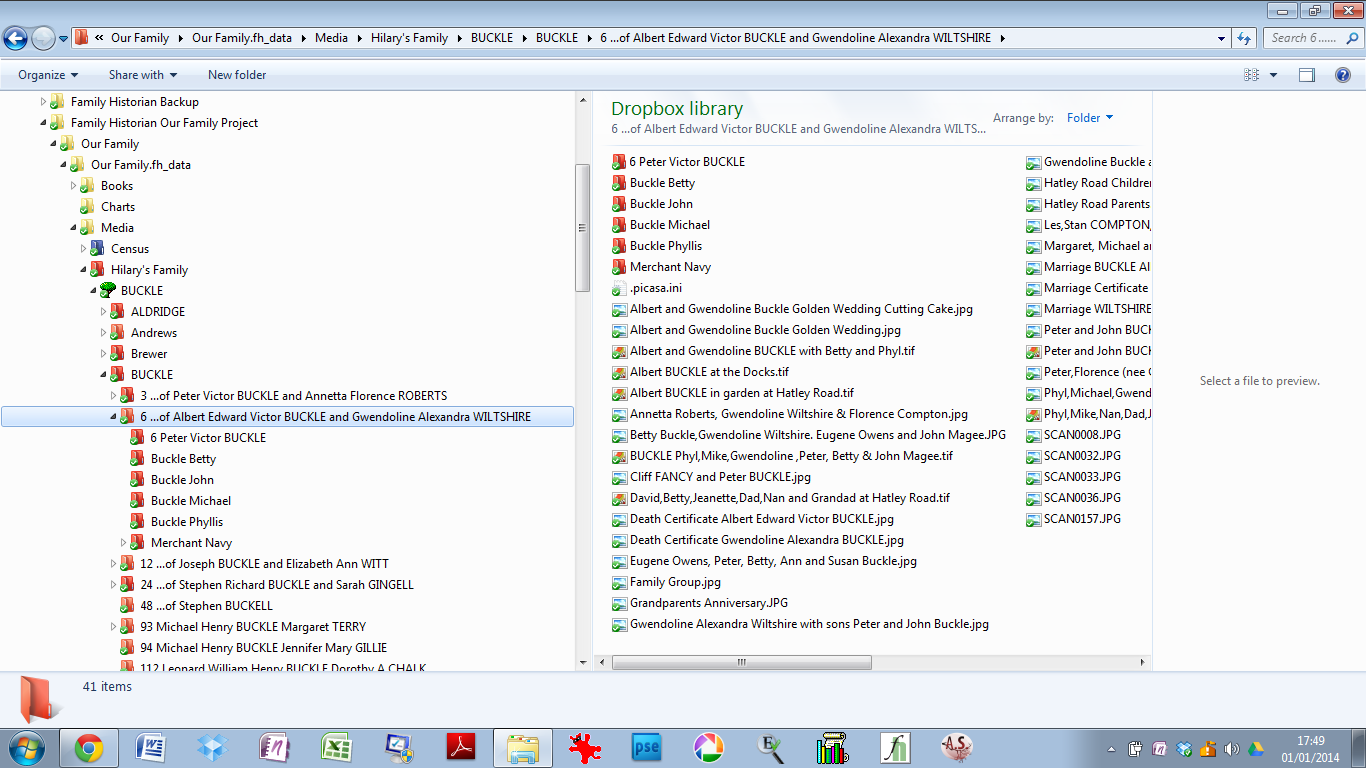
Most of my data is genealogy related and my genealogy program Family Historian http://www.family-historian.co.uk/ allows for everything to be stored in a Project folder. Many items were already in this folder but I was not happy with how it was organized. Most of my photographs are of living individuals but I also have some of gt gt grandparents. I have other digital images and many more left to scan. I have paper files which I also need to organize and wanted to file in a similar manner and had started to rearrange by family.
So how could I organize everything in a consistent manner.
Although some of the more recent photographs will contain members of both my husband’s and my family I decided that organizing using family groups was the best approach. Wedding photographs would be filed under the couple unless they contained an individual alone. Individuals would be filed under their family at the time the photograph was taken so that children would stay with their parents until they married.
Birth and Baptism records are with the parents family whereas marriage and death are with their family at the time of the event. This fits in well for those individuals who married several times and those who never married.
Before subdividing to the families I organize by surname which allows for documents pertaining to more than one family.
I also capitalize the Surnames in the main tree to distinguish them from the other surnames linked into the main tree by marriage.
Each of my son’s grandparents has a different colour assigned to their line. The folders are then coloured using a program called folder marker http://www.foldermarker.com/ .
This program also allowed me to change the Icons for the main folders to a tree.


Finally I discovered a program called Bulk Rename Utility http://www.bulkrenameutility.co.uk which I have started to use to clean up my file naming. This allow you to take several files and rename them in a single action and removes some of the tedium associated with this task.

So my resolution for this year is to complete this task.
Once I have completed this my next task is to reconcile my sources with what I have recorded in Family Historian http://www.family-historian.co.uk/ this I aim to do using Evidentia http://evidentiasoftware.com/.
The developer of Evidentia http://evidentiasoftware.com/ has a new version in beta testing which is due to be released later this year.

My aim is to get this first task completed before the new study group for Mastering Genealogical Proof http://www.ngsgenealogy.org/cs/mastering_genealogical_proof starts as I know I will be busy with this being one of the panelists. This will have a UK slant and will I believe show how the principles of research and analysis in genealogy apply wherever your research and documents are to be found.

I also plan to use Evernote https://evernote.com/ and Onenote http://office.microsoft.com/en-gb/onenote/ to help further my organization skills as I am aware that these are invaluable tools for many genealogists.
I have started using both but have not yet decided exactly how to get the best out of them.

To help me with all this I have signed up for the next Hack Genealogy Boot Camp http://hackgenealogy.com/genealogy-groove-boot-camp-25-january-2014/ and I shall continue to join Legacy Family Tree Webinars http://www.familytreewebinars.com/ and Google + Hangouts http://www.google.com/+/learnmore/hangouts/ to get hints and tips from others.

Thank you for reading my blog and if you have not already seen it please have a look at this new blog http://worldwidegenealogy.blogspot.co.uk/ a collaborative blog which will have contributions from across the globe including yours truly.

Friday, 28 June 2013

Should I Change the Way I do my Genealogy Research?

If you read my previous post on the discussion surrounding a new book called Mastering Genealogical Proof and followed the links you will already have some idea why I have chosen this title.

From the Contents page
Chapter 1 Genealogy’s Standard of Proof
What is genealogy?
Why a genealogical proof standard?
The Genealogical Proof Standard
Modern technologies and genealogical proof
Research and reasoning cycles
Using the GPS

So What have I got from the study group discussion of Mastering Genealogical Proof Chapter 1?

Why do we need to have a set of rules for our research?
We are looking at kinship, relationships of  others to ourselves. We will only have known 2 or 3 generations of our family personally at the most and some of what we know will be hearsay. We look for records to support what we know or have been told but without some guideline how do we know when we have sufficient evidence to support any conclusion we might draw.

Why do we need to set goals?
We need to set goals in order to stay focused.
If we get a negative result this can be as important as a positive one but it is easy to overlook these, leading to repeated fruitless searching.
With historical records there are going to be plenty that are no longer extant.
Those records which may prove to be a "linch pin" in the argument may be the last record we find but if we do not set the right goals we may think we have the evidence we need when it is not conclusive.

Why should we adhere to standards for both our own work and the work of others?
If we want our work to be credible, we need to be sure of our conclusions.
If we fall short in any of the areas covered by the genealogical proof standard then our research can appear worthless.
We should be able to reproduce the work so that we can reassess it if further evidence comes to light.
Conclusions are only as good as the evidence supporting them.

To conclude this post and answer the overriding question of changing the way I do my research I must consider what I have been doing and how I might improve what I am doing.

Like many who live a distance from where their family came from I find limited time for archive research.
We all use the ever expanding online records and these can help us make the most of our research time. However a once a year trip can mean we are keen to gather as many records as possible without truly evaluating their worth.

I aim to organize and evaluate my current records so that when I next visit an archive I will have a much clearer idea of what I want to find and by properly evaluating what I need I may find that I can order records without having to visit in person.

I think Evidentia will allow me to better evaluate what I have and recognize where I have gaps in my research.

Even without the book the discussion is helping me look at what I do and how I do it.

Wednesday, 26 June 2013

How to avoid "Genealogical Drifting" - a discussion of Mastering Genealogical Proof with DearMYRTLE

Just a few thoughts on the Mastering Genealogical Proof study group at DearMYRTLE's community on Google+.
I have watched the discussion of both Chapter 1 and 2 and wanted to get down some thoughts.
First a comment on the title of this post.
Drifting to me is going along with the flow.
It is a word mentioned in both of the 2 study group sessions I have watched and I think it requires an explanation for its use in this setting.
How many of us have started out researching with one goal.
We find  a record, but then get carried away on a different tangent (and with so many online records now this can particularly apply to online research).
It is so easy to become a “genealogical drifter”.
If we learn anything from these hangouts it should be how to avoid being a drifter or how to get the best out of our research time by looking at our goals and assessing the information we have found in a more consistent way.
 I have not seen a copy of the book Mastering Genealogical Proof as I live in the UK and felt that shipping costs would be prohibitive. If an ebook becomes available or it becomes available to purchase in the UK I hope to obtain a copy. It is currently available to order but is not expected to ship until July.
So given the background and that I have not seen the book what can I as a genealogist get out of these discussions.
By understanding the principles discussed in the book we set ourselves a guideline by which we can assess the value of the information we find.
If we use the collect and review approach correctly we can avoid looking for the wrong information in the wrong place at the wrong time.
I think that this book may make many of us think about how we do our research and it may turn the whole research process on its head for many.
We all like to feel we are doing things the right way but without discussion and good advice or training from others more experienced or knowledgeable we may not be doing things in a way that gives the best results.
We can all point out errors we have made in our research, we have our failings.
The popularity of a group on facebook called The Organized Genealogist and the postings within the group show what a battle many of us have to be organized.
If you have to travel far and maybe even need to stay overnight in order to carry out research or if you have to pay someone to produce a copy of a record for you it is important that you do the preliminaries with the utmost care so that you can make the most of research time and order the correct piece of information. By understanding the importance and relevance of our information sources we improve the whole research process.
Looking at the contents pages for the book the first 2 chapters lay down the foundations for the details discussed in the later chapters. Without good foundations your work will crumble so I will conclude my initial comments and review the 2 videos once more for further comment.

Please read the book and the homework answers submitted by the study group.

If you have not been following any of the discussion you can catch up with it at http://www.youtube.com/user/DearMYRTLE/videos and the comments can be viewed at https://plus.google.com/u/0/communities/104382659430904043232?hl=en where you will need to join the community to read the posts.

For more information about the book and how to obtain a copy go to http://www.ngsgenealogy.org/cs/mastering_genealogical_proof

Monday, 27 May 2013

 How can Evidentia work for me?                   


Genealogists come in all shapes and sizes but there is one thing that most of us strife to do but very few of us really do well.

What is it that we are so bad at but is really so important and should be the one thing that we would hope to do right?

We are endlessly told how important it is to cite our sources.
Why is this so important?

Well as any experienced researcher will tell you, I wish I had documented my sources so much better when I first started (remembering to date and document what you can remember of a conversation with an older family member, or noting all those negative searches which you repeat a year later even though there is no change in the information).
Most of us have been there and it is so difficult years down the line to be sure what you have or have not done in the past.


Secondly how many of us have entered a source thought we had got as much from it as we could find only to go back years later and realise it held clues which now fit into the bigger picture.
I have 2 marriage certificates with witnesses whose names I did not recognise who later turned out to be members of the family by marriage or illegitimacy.


When I first saw Evidentia being used by other genealogists on a Google+ Hangout I was not sure whether I was ready to embrace using it to enhance my research process.

To see how Evidentia works have a look at the videos on the developers YouTube Channel http://www.youtube.com/channel/UCYKbwE4VYrXm--D2FF7hZ7Q/videos
You can also get a 30 day trial to see whether you think the program will work for you. 
Like most programs the first version will not be perfect but the developer is working with users to improve the program so that it can be a great resource for the genealogy community.


The timing in relation to the release of a new book by Thomas Jones http://www.ngsgenealogy.org/cs/mastering_genealogical_proof could not be better.
Evidentia will make you think about how you record your source and about what that source is telling you. It will also help you to decide whether what you have is sufficient to support the facts you have documented.
Analysing the evidence is not new and is something we should all be doing but how many of us are doing it well.

When I document a source I need enough information so that anyone including me can go back and find that information at a future date. Quoting just a url and a date accessed is not enough as tomorrow that url could change the internet is an ever changing source of information and even archives can move so don’t forget to record as much as you can about your source.
In Evidentia you can use templates provided or create your own which can be a great way to remind you what you need to record from those commonly used sources. 

Could these templates help when we are recording our research? 
I know I have got back from a research trip only to find I have forgotten to record something.

Could Evidentia help by producing a template for further research when we have analysed what we already know?


I have not got a copy of Mastering Genealogical Proof as shipping to the UK is likely to be expensive, but if this book deals with the topic of extensive research then it may be that Evidentia will be able to guide users as to how extensive their research needs to be in the future.

I have on my computer a program called Gensmarts which I had hoped would help in this respect but like most programs if what you have recorded is poorly inputted then you do not get meaningful results.


I have high hopes for Evidentia and would 
encourage all serious genealogists to give the program a try. In the absence of anything to replace or update Gedcom this program could be a significant tool.

Sunday, 5 May 2013

Are we as Creative as Our Ancestors were ?


This post was inspired by a post made by Thomas Macentee http://bit.ly/157Yhxu .

So how many of us make our own clothes. Very few is the first answer to come to mind. 
I read somewhere that John Lewis is cutting the area it has for fabrics and other handicraft items but that there may be an increased demand for these items in times of austerity. 

When I grew up (being a child of the 60s) girls would have been taught skills such as needlework at school. We were also taught how to cook. Both skills our parents and grandparents would have been expected to learn at home.

My grandmother brought up in an orphanage at a time when many young girls went in to service would have been taught these skills to ensure her employability. Skills she would later use when she had her own family. I well remember the school jumpers or cardigans that she would knit for us when we were children.

Even after the industrial revolution when fabrics were cheaper to produce the everyday working class of this country would make their own clothes as a necessity rather than a matter of choice.
Alongside this change from homemade to shop bought have we also lost other traditions in our culture?
 In the days when most people attended church on a Sunday the working class would have a set of best clothes often referred to as “Sunday Best”. Does anyone have a set of best clothes today?

“Home made” items also bring to mind organizations such as the Women’s Institute (WI) with the label “Jam and Jerusalem” which many turned their back on but may see a resurgence with all the food scares we have seen.

We will never turn the clock back and society has changed and all of us should ensure we record what we remember of our own past as this will be the stories our families want to read, but have we lost something more fundamental when the basic skills of cooking and clothing ourselves have been lost by the majority.

Should making anything from the basic ingredients be a hobby or should we return to the days when we taught children how to cook and sew at home and backed this up with school tuition.

How many of us have children who cannot even cook?
Has the era of ready meals really done our children any favours?
Do we create less than our ancestors?

Friday, 22 March 2013

Family Stories Getting Our Family to Engage

I have been watching the livestreaming from Rootstech at http://www.rootstech.org/ and in this post I will discuss the main points I have gleaned from the first day Thursday 21st March 2013.

ThursdayPresented by findmypast.com
8:30 AMKeynote – Dennis Brimhall, Syd Lieberman, Josh Taylor
11:00 AMThe Future of Genealogy - Thomas MacEntee and pane
l1:45 PMTell it Again (Story@Home) - Kim Weitkamp
3:00 PMThe Genealogists Gadget Bag - Jill Ball and pane
l4:15 PMFinding the Obscure and Elusive: Geographic Information on the Web - James Tanner


The message from the morning sessions can be summed up for me with the following phrases.
How do we get the younger generations involved more.
What are we leaving for our descendants of our lives.
Storytelling brings others into your world and helps engage those who may think family history/genealogy is boring.
We need to use technology to get our messages across.
Do we need technology designed for genealogy? 
Surely social media should be treated as modern day letters and we should be saving our tweets and facebook posts?
We need to think what our descendants want to know about us.
There are plenty of official records but are these enough.
Will our descendants have access to official records and what will these records say about us.
The future of genealogy is in our hands.
We need to make the right choices.
Do you want someone to be interested in what you have done, if so how are you going to get them to pick up that book, look at that photograph or document, listen to that story and visualise that moment in time and how that person may have felt, where they were and what living conditions were like.
With the information we have in our records and on the internet we need to paint a picture to Tell Our Story to engage Our Family.

If you have not managed to see the presentation by Lisa Louise Cooke  on using Google Earth I would recommend you try and catch up with her DVDs as I believe this is a great way to visualise your heritage and it can be updated.

Also have a look at the article in the April 2013 edition of the Who Do You Think You Are magazine discussing a world tree.

Above all we need to SHARE if we want to GROW.