Pages

Sunday, 10 September 2017

GenDoc Study Group 1

gendocstudygroup_logo_2x.png


Thomas W. Jones, Mastering Genealogical Documentation, (Arlington, Virginia: National Genealogical Society, 2017.) Softbound available from the publisher’s website www.ngsgenealogy.org.

Hilary Gadsby

Chapter 1
“The Purpose and Nature of Genealogical Documentation”
As a study group panelist I have been asked to write about a part of the chapter that speaks to me.
Why do we need to document what we do?
We spend many hours searching for the answers. We discover information in various ways. We may find direct answers or have to pull information from several places before we can draw any conclusions.

If all that you record is a conclusion how will anyone know how you reached that conclusion. If you need to look at a record again would you know where to find it?

We often find sources may contradict or provide incomplete information. This may require a rethink of our conclusion.

When the source of information is recorded as fully as possible it can add weight to any discussion that may be included with the conclusion.

The type of source and how it is presented can have a bearing on its reliability.

For example a clear digital image of an original document which was recorded at or close to the time of an event by an official or first hand witness will be a much better source than a smudged microform record which could be a transcript of the original.

Why is it important how we document our research?
Citation helps you understand your source
Citation shows what supports your conclusion
Citation allows for repeat evaluation
Citation prevents accidentally plagiarising

Poor documentation can hide both good and bad research. By providing good documentation any gaps or misinterpretation of the sources can be revealed.

We can better understand whether we will meet the standards expected of competent researchers if we cite what we use.

It may be years before we can reach a conclusion. We need to be able to look back at our research and review before we repeat rather than further our investigations. With experience comes a greater understanding.

My aunt told me that there was a child that died young.
I included this piece of information as an interview with her before she died in 2003 (Being a novice then I forgot to record the exact date and I know I visited more than once). I can document this now but not as well as if I had recorded the date of the interview.
I have entered information here  Story on Family Search Family Tree.
Fourteen years after her death I finally find documents to support this.
Joseph Buckle (1868–1940) Elizabeth Ann Witt (1870–1937) Albert Edward Victor Buckle (1902–1985) Leonard William Henry Buckle (1907–1977) Henry Joseph Buckle (1895–1895)


Then I searched for more information and found it in a newspaper.

Premature Birth The Hampshire Advertiser August 28 1895 Page 2 Column 6 Paragraph 4
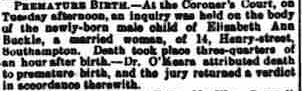

"Premature Birth,"  28 August 1895, p. 2, col. 6; digital images, Find My Past (http://www.findmypast.co.uk/ : accessed 9 Sep 2017), British Newspaper Archive. Cit. Date: 9 Sep 2017.  


Research is a process and like making a cake if you avoid adding an ingredient (don’t write a citation) the final result may not be what you expect.

Crafting a citation is an important step in communicating your understanding of your source. When we were discussing  ESM Quicklessons I compared some certificates in my possession. This illustrates that just citing as a birth, death or marriage certificate was not enough and to understand fully what we have used we need to know more about the qualities of the source.
To take this further look at the second image. I can now compare this to a digital image of the parish register.
The transcription can be found on Find My Past website. But this does not reveal the names of any witness to the event who could be a family member. They do however have digital images as shown below.
Here is Robert Rosling on the Family Search Family Tree.


The digital image above actually shows the witnesses and reveals the transcription error made at either the register office in Oakham or when recording in the register held at the register office. I had tried accessing the parish register entry on microfiche held at the Rutland Museum in Oakham but the entry on the microfiche was unreadable.

I have not added any citations to most of the above. The newspaper citation was created using a Legacy template. There are not templates available for every record I want to cite so I need to craft my own and I hope that studying this book will help it become second nature. When we have finished I am going to add citations as footnotes on this entry.
For those that like templates beware I found an error in the Legacy template for the 1911 census for England and Wales which I reported and they said would be fixed. I have not checked whether this has been done yet. So if you find something in a template that does not fit or appears to be missing report it to the software development team.


I have used 2 ways of showing family relationships in this post which one do you find illustrates the best. The diagram or the link to Family Search Family Tree.

Monday, 26 September 2016

ESM's QuickLessons A DearMYRTLE Genealogy Study Group Lesson 21 and Writing Historical Biography


Hilary Gadsby

QuickLesson 21: Citing DNA Evidence: Five Ground Rules    
Elizabeth Shown Mills, “QuickLesson 21: Citing DNA Evidence: Five Ground Rules,” Evidence Explained: Historical Analysis, Citation & Source Usage (https://www.evidenceexplained.com/content/quicklesson-21-citing-dna-evidence-five-ground-rules : accessed 24 Sept 2016).     
and
Writing Historical Biography
Elizabeth Shown Mills, “Writing Historical Biography," Evidence Explained: Historical Analysis, Citation & Source Usage (https://www.evidenceexplained.com/quicktips/writing-historical-biography : accessed 24 Sept 2016).


Welcome to my final blogpost for this study group.

I looked at these topics and thought how can I relate these to my own research. I have not done any genetic testing of either myself or any close relatives and I have not as yet attempted to write a historical biography.

So I cannot write from experience but I can say what I understand and how I would approach this.

ESM mentions "five basic ground rules"

Evidence versus citation

All we do when we write a citation is identify our source. In relation to DNA results these will have been analysed and presented in a particular format we cite how they have been presented to us (what we see). 

DNA is evidence

We take information we find in our source and use what it is telling us in building the evidence supporting or refuting our assertion. The same as any other source.

Citation to support an assertion

The information may need further analysis, to provide us with the evidence to support or refute an assertion that X is related to Y, but this is what we can add to our dicussion rather than a citation. Whatever the outcome of the discussion citing the source will not change.

What are you citing?

How has the result of the test been communicated to you. Have you been presented with a comparison to others held in a database?

You may need to explain what you are citing

Some citations are in need of explanation it may not simply be a case of including a name and date. We include sufficient information to clarify any specific item of interest.

The only thing I will add here as I have no specific example is that when we are dealing with genetics we are using information from living or sometimes recently deceased individuals. Given that even if an individual is now deceased they may still have close living relations we need to ensure we follow the guidelines. Elizabeth Shown Mills has a number of publications available including one on genetic sources and there is information available on the website for International Society of Genetic Genealogy.


Historical Biography

Whilst I have not as yet written any biography be it my own or anyone in my family I have used some of the records suggested.
If we wish to present an interesting picture of our family to others, be they family or friends, then we need to include more than a list of dry facts and possibly a few photographs. Technology may allow us to present things in a more interactive manner but first we need to find the information.
Census information, certificates, church registers tell us who was related to whom and when births, marriages and deaths may have occurred but they tell us little about how our family lived and interacted with others in their community. It is likely that our own lives have changed considerably over our lifetime and the same is likely true for our ancestors.
Whilst we may not have met someone we may still be able to build up some kind of picture of the life he may have lead.

I will show you an example from the half brother of my great grandfather Rowland Curtis.
We find his memorial at Find A Grave in Warminster.
This is incomplete and tells little about who he was and the family he had and any struggles he may have faced. He is recorded in the Family Search Family Tree with the currently available documents.

I have not included what I have found in the newspapers and books about Warminster.
It appears that this family were mentioned in the newspapers on several occasions.
The local newspaper is The Warminster and Westbury Journal and a search at Find My Past in the British Newspaper Archive returns several results.
They even made a national paper known as Lloyds News. The local paper included a copy of the original but unfortunately without the photograph.


"London Interviewer's Visit to Warminster," The Warminster and Westbury Journal, 28 March 1908, p. 6 col 3;digital images, Find My Past.co.uk (http://www.findmypast.co.uk : accessed 26 Sept 2016), British Newspaper Archive Collection.

So what do I need to do with this information? 
What else do I need to look for and how can I get this in to a format that the family will find interesting? 
I have found a photograph of the family in a copyrighted book page 112. There are also photographs of another family member on pages 58 and 59 in the same book. Danny Howell. Yesterday's Warminster (Buckingham, England: Barracuda Books Limited, 1987)

I am using Twile to collaborate with the family and I am going to add these to the website to help the family know more about who these people were and how they lived. I am always looking for more information and because it is a private website copyright issues may be less of an issue.  
I can share more in a private invitation only area than on public trees and I hope that it will be able to connect to my blogs and other sites to avoid duplication. The timelines and maps along with historical information can really bring our own history in to context.
There are plans for Twile to connect with Family Search but I will tackle any issues, I might have, if they become a problem. 

Like many I have gathered the information to write more about my ancestors but have rarely pulled it together to create something more this is something I hope to do on my family blog, maybe I should start with Rowland Curtis, but hey I have already started.


Sunday, 18 September 2016

ESM's QuickLessons A DearMYRTLE Genealogy Study Group Lesson 20


Hilary Gadsby


QuickLesson 20: Research Reports for Research Success
Elizabeth Shown Mills, “QuickLesson 20: Research Reports for Research Success," Evidence Explained: Historical Analysis, Citation & Source Usage (https://www.evidenceexplained.com/content/quicklesson-20-research-reports-research-success  :  accessed 17 Sept 2016).

This week we will be discussing the research process.

How do we do our research?

How should we do our research?

Can we improve how we research?

With the growth of the internet how many of us can find ourselves joining in with the quick click genealogy we frequently criticise.

Why do we criticise this way of doing things?

  1. Insufficient preparation
  2. Poorly recorded
  3. Insufficient analysis
So what should we be doing?
Ask yourself these questions.
  1. What do I want to find?
  2. Where should I be doing my research?
  3. How am I going to do the research?
  4. How am I going to record what I find?
  5. How am I going to review what I find?
We can use pen and paper or our computers to assist in these tasks.

We know how to interrogate the databases online and how to enter our results in our software program. There is plenty of information to tell us how to do this either digital or paper.

Do any programs tell us what we need to look for?

Do any programs tell us whether what we find is relevant?

Poor preparation and lack of analysis can lead to hours of wasted research.

How can we know what we need to find if we have not analysed what we already know.

Creating a research plan will be the best thing you do. It will keep you on track. 

If we wish to move on from being just "information gatherers and processors" as ESM states in this lesson we must consider how we approach our work.

This weekend I came across an individual who had been recorded by another researcher in the Wiki Tree website with the maiden name of ROSLING. However this was not the surname for the parents. The link to the 1911 census revealed that she was recorded as their adopted daughter. There was also a link to an army record showing her date of birth in keeping with the census record.
I am researching the surname ROSLING and was interested in knowing where she fitted in the lineage I am constructing.
If I just entered her name in a search would I find anything and how would I know if what I found was relevant.

Experienced researchers will often know exactly where to research and which records may help them find what is available. This does not preclude them from the planning stages but it may reduce the time needed to formulate the plan. Even the experts find themselves stumped occasionally and have to consider alternative strategies. Researching in a new area be it geographical or an unfamiliar set of records may require a different skill set and a whole new learning experience. If we are to complete a thorough research we have to be aware of the resources available. 

Even the best plans may need to be altered in the light of new information. Being prepared and analysing what has been found may alter our focus or the manner in which we carry out our research.
The ability to plan and analyse helps us make better use of the research time.

Complex questions may only be answered if we look at all the information we have and understand what it's telling us. 
Some researchers have found that a program such as Evidentia can help them formulate a plan for these complex problems. By entering each piece of information deciding what it is saying and importantly how reliable that information may be we have a clearer understanding of what we already know. 
The source of any information may be flawed. Awareness of the reliability and being able to resolve conflicting information are analysis skills that may only come threw experience and education. 
Learning from others and sharing personal experience helps each of us become better researchers by improving the knowledge base.

Do we read any accompanying information about a record group that we find online before we enter a name in the search box. If not, why not, surely we need to know if the record will be likely to provide us with the information we need before we search. Would you travel miles to an archive or cemetery without checking that they have what you are looking for first. The same should be true for online records. Finding information and blindly entering it into a database is as boring and pointless as writing lines was as a school punishment. If you want the reward of finding that elusive connection you need to spend time preparing and analysing, formulate a plan, familiarise yourself with what may be available, pinpoint the best way to approach the task and adapt the plan as and when more information is discovered. Not forgetting that negative results do not mean negative evidence, it may be that any record has just not survived.

As we near the end of this study group, we need to pull together all that we have discussed.

I am writing about my research mentioned above on my One Name Study blog. I have not included specific examples this week as I believe that this lesson is more about understanding the process and the importance of doing this well. 
Only we as individuals know whether we have been disciplined in the past.
Hopefully our discussions may have helped at least one of those watching to become researchers rather than gatherer/processors.

Researching when few records or indexes were available online and internet access was expensive.  
I was not aware of research plans so I would go armed with notes that I had made to guide my research. 
Whilst looking for ancestors in the BMD indexes on microfiche I would have a name, range of years, and geographical area. When I found a possible candidate I would record and order a certificate. 
The only way I could access the census was using indexes and then when I could get to the local archive I would have to scroll through the microfilm to find what I wanted. 
The internet has made finding many records easier but has it also created a group of individuals who may believe the adverts that show families building trees using only the online website. 
No website will ever contain all the records and whilst the records support our research they are not the researcher. 
Who pieces together which record is relevant to each individual, who is related to who and how are all these individuals related, it is us as researchers who analyse the information and decide its relevance.

The reporting suggested by Elizabeth Shown Mills may sound quite prescriptive and academic and unless you have an academic background you may switch off at the thought of report writing. However what she is saying is this. 

  1. Compile your findings complete with the information needed to find them again. 
  2. Collect them together in a manner that you are comfortable working with or that fits with your findings.
  3. Summarize what you have found.
  4. Decide whether you have answered your research question.
  5. Decide whether you need to do more research and create a new research plan.
  6. Make a conclusion and write a reasoned report to support this.
Personally I would say that Evidentia will help you do all of these in a guided way.

Finally here is a link to a Google Sheet I created called The Family History Research Process. It contains links to documents that others may find useful. Please add your comments if you think I may have missed something useful that could be added.

Monday, 12 September 2016

ESM's QuickLessons A DearMYRTLE Genealogy Study Group citing digital images on a website


Hilary Gadsby

Citing digital census images on LAC - not Ancestry    
Elizabeth Shown Mills, “Citing digital census images on LAC - not Ancestry," Evidence Explained: Historical Analysis, Citation & Source Usage (https://www.evidenceexplained.com/content/citing-digital-census-images-lac-not-ancestry : accessed 27 August 2016).

If you are a regular reader of this series of blogs, dealing with the topics being discussed by the study group, you will have seen my previous post. (If you have not read it, may I suggest you do so, as this post relates to what was discussed previously.)

Some of you may have gathered that I do not read ahead but rather tackle each lesson as it comes. 
If I had looked at the topic for this week I may well have written my previous post to cover the discussion this week.

To illustrate the points I mentioned previously, here I will take an image from each of the websites so that the citations can be compared. 


I have chosen a baptism record from 1794. Here is the page at Lincs to the Past and Find My Past.


You will need a subscription to Find My Past covering the UK records to access the page.


This is the image as I downloaded it on 18 May 2015 from the Find My Past website. I have kept the original file name GBPRS-LINCS-SWINSTEAD_PAR_1_2-0236 and have filed it with other downloads from that parish. (The significance of this name will become apparent as I build my citation)

From looking at the images on both websites it is obvious that they are essentially both images of the same page of the register. If I had viewed the original register at the Lincolnshire Archives where it is now being stored my citation would be without layers.

The layers are being added to explain how I accessed the record I viewed. The Lincolnshire Archives have their website organised so that you can see the hierachy of their cataloguing.

Repository: Lincolnshire Archives
Swinstead Parish Records: SWINSTEAD PAR
Registers: /1
Baptisms and Burials 1794 - 1812: /2
Image 2 of 8 (1794 - 1795)

Reference: SWINSTEAD PAR/1/2 

The register is unpaginated and not numbered so any record from this page needs to include the full date.
The parish church for Swinstead is St Mary but there is no reference to this on either website. Being a small parish there is only one church so it is not important but in cities or towns with several churches it is important to quote the name of the church.

The title given to the downloaded image from Find My Past contains important information about how this record has been catalogued by the archive but there is no mention of this on the website. 
I find records of interest on this site but find it very difficult to build useful citations for what I have found due to the lack of information on the site. If the records they are hosting disappear will I be able to find them easily at the archive where the originals are kept. Since the purpose of citations is to allow anyone to find that same record again it is frustrating that websites may not make my job straightforward.
I had intended to compare citations for this record on the 2 sites, but whilst understanding what I have in the image, I find actually building the citation from the information provided is not possible without making assumptions.

Sorry if this is a bit short if you want to know more please watch the video. 

Tuesday, 23 August 2016

ESM's QuickLessons A DearMYRTLE Genealogy Study Group Lesson 19

Hilary Gadsby

QuickLesson 19: Layered Citations Work Like Layered Clothing    
Elizabeth Shown Mills, “QuickLesson 19: Layered Citations Work Like Layered Clothing,”Evidence Explained: Historical Analysis, Citation and Source Usage(https://www.evidenceexplained.com/content/quicklesson-19-layered-citations-work-layered-clothing : acessed 17 Aug 2016).         
and
RE: QuickLesson 19 - Layered Citations / Penned Question
Elizabeth Shown Mills, “RE: QuickLesson 19 - Layered Citations / Penned Question,"Evidence Explained: Historical Analysis, Citation and Source Usage(https://www.evidenceexplained.com/content/re-quicklesson-19-layered-citations-penned-question : accessed 17 Aug 2016). 

Using layering is becoming more important with the proliferation of digital records on numerous websites.

We need to understand the source of any information we are using to provide evidence for our assertions.


I use the website Find My Past for research and have found records of interest in the 1939 Register. On the website I can view both the transcription and a digital image. The transcription and image may not match so it is important to look at both.


I was looking for a relative Ruth Gadsby who I knew was born in 1901 and had died before the cut off date when the register ceased to be used by the NHS. She should be there so I looked for her with her birth year.


I eventually found her with a birth year of 1910.


Here is the part of the image with the entry.


It is obvious when you see the entry how the mistranscription happened. So citing that you viewed the actual image and not just the transcription is important to the accuracy of what we record.

My second example comes from Find My Past again.
Some of the images on the website are not fully indexed and do not show up in the records when you do a general search.

If I do an A-Z search of the records for Lincolnshire here is what I saw today.


One of these record sets states Lincolnshire, Parish Registers Browse 1538-1911.
Here is what I find when I filter down to the parish of Swinstead.


However this is not the only place online where I can find images of the parish registers. The website Lincs to the Past was the first host and still hosts images from the registers. If you type swinstead par1 into the search box on the website it brings up all the registers which, apart from the post 1837 marriages, are viewable on the website.

Let me compare them.


This register does not exactly match any of those record groups on the Find My Past website. They appear to have broken the register images into smaller groups.


This register has been included with part of another to cover these events from 1780 on the Find My Past website.

This book (PAR/1/3) has been combined with the later register for marriages (PAR/1/5) as a single group at Find My Past.


Only Baptisms (PAR/1/4) and Burials (PAR/1/7) have been kept as the same record group catalogued the same as the Lincolnshire Archives. The Baptisms and Burials 1765-1780 are missing from the Find My Past website but are viewable at the other website.

Citing the records viewed on the Find My Past website is going to be extremely difficult as they do not provide the necessary archive references and have not grouped the images in the same manner as the original archive.
The only way we can cite these records at Find My Past is to state the record group where we found them on the day we searched and that the original registers can be found at Lincolnshire Archives. It is unfortunate for us as researchers that we cannot use the reference used by the archive as this is likely to be useful to others should Find My Past no longer host these images.

To sum up we must be certain with our citations to record exactly what we used. Do not include archival references unless they are explicitly stated as the organisation on the website may be different.
Many websites licence the images and may only host them for a limited time so be certain to include a date accessed and as much detail as needed to be able to find that record again.
A record found on one website may appear to be the same as another, but sometimes there were more than one copy made of the original or the original may have been copied, ensure you know what you are looking at so that you can explain any differences.

Monday, 15 August 2016

ESM's QuickLessons A DearMYRTLE Genealogy Study Group Lesson 18


Hilary Gadsby

QuickLesson 18: Genealogy? In the Academic World? Seriously?    
Elizabeth Shown Mills, “QuickLesson 18: Genealogy? In the Academic World?” Seriously? Evidence Explained: Historical Analysis, Citation & Source Usage (https://www.evidenceexplained.com/content/quicklesson-18-genealogy-academic-world-seriously : accessed 14 August 2016).


This QuickLesson was published 9th January 2014 and the discussion of how Genealogy and Family History has been perceived by the academic world and whether it is, has or will change is not static. 

The interface between professional, academic and hobbyist in the field of genealogy can be fractious due to competing or conflicting demands. 
Conflicts due to differing perceptions do nothing but harm. 
The struggle to prove that genealogical skills need to be taught as an academic discipline when there are financial constraints and competing demands. 
Ensuring that there are standards in place and that they are observed by all involved.

Bloggers have posted about this. Thomas MacEntee, Tony Proctor and more recently Amy Johnson Crow.

Whilst those who might class themselves as genealogists or family historians are possibly starting to form a more cohesive group with more online courses both paid and free (the online course run by Future Learn, created by the University of Strathclyde, last year had thousands of participants worldwide and is currently running again). 

The acceptance of genealogy as an academic discipline may not be so easy to achieve.

The skills needed to create accurate family histories are multifaceted they would ensure the graduate would have transferable skills for many occupations. 

Where many hobbyist family historians can fall down is that, whilst they may know where they obtained a piece of information, they do not always accurately record this. Sound conclusions can only be made when we take care to look at all of the information and review it with an open but critical "eye". The proliferation of inaccurate poorly documented "genealogical trees" on the internet does much to tarnish academic interests. It is in the interests of everyone that these inaccuracies are highlighted and education at all levels is paramount.

Many societies have a tradition of oral histories and until very recently "the masses" would have relied upon this. Only the elite in society could have access to, or afford, those who could write or paint. Official records only exist where law or tradition required them.
The advent of photography and other means of recording have added alternative means of passing on the information but as with any other media are prone to errors. 
Genealogists need to have the skills to know how to handle conflicts which is a skill that comes with knowledge and experience. Academia can assure that these skills are passed on by providing the education to the next generation.

This study group and others that have been hosted by DearMYRTLE, even the less formal discussions, are an ideal learning environment for all. (be they beginner or professional/ academic) 
They provide a platform for discussion and alternative ways of getting the information across to anyone and everyone.

Monday, 8 August 2016

ESM's QuickLessons A DearMYRTLE Genealogy Study Group Lesson 17


Hilary Gadsby

QuickLesson 17: The Evidence Analysis Process Map    
Elizabeth Shown Mills, “QuickLesson 17: The Evidence Analysis Process Model,” Evidence Explained: Historical Analysis, Citation & Source Usage (https://www.evidenceexplained.com/content/quicklesson-17-evidence-analysis-process-map : accessed 6 August 2016).    
and
Negative Findings / Negative Evidence
Elizabeth Shown Mills, “Negative Findings / Negative Evidence,"    Evidence Explained: Historical Analysis, Citation & Source Usage (https://www.evidenceexplained.com/content/negative-findings-negative-evidence    : accessed 6 August 2016).  


Before I start any discussion on this topic I want to highlight what I consider to be the most important point from this lesson "the extent to which we understand the language and structure of evidence analysis will determine the success of our research."

This mindmap I created shows the elements of the Evidence Analysis Process Map as shown on her website. (with additions)


We have talked about how important it is to use reliable sources and to cite the sources we have used. However if we are to do this effectively we need to know what we have and what it is telling us.

We should not overlook the obvious sources such as family with firsthand knowledge, who despite memory lapses, may have more complete firsthand information than anything written on paper.

Getting as close to original records as possible can help reduce bias caused by poor transcribing. Video or sound recordings, letters, photographs and other family memorabilia can all support our family story and can help recall memories.

We may only find sources which are distant from an event, so we need to consider the relevance of this distance, upon the reliability of the information. A person may have been a firsthand witness to an event, but as the years pass their memory concerning exact details may not be the same as it would have been, if recorded close to the time of the event.

Uncertainty regarding the informant for any piece of information casts doubts on its usefulness in building a proof which is why official signed records may be considered more useful than a family legend of unknown origin.

Our interpretation of the information allows us to use it as evidence to support our conclusion.

The best way to show is by example so I am going to show someone I came across on Family Search Family Tree who has 44 sources attached. How many of these are for this person? Can we remove some as we interpret the sources.


If we look at her christening this fits with those of her siblings and is supported by this source.
The marriage as indicated would suggest that she was still in Bedfordshire when she married in 1773.

But did she really have 33 children!

If we look at the birthplaces of these children it is not until we get to Charles Wiltshire christened in 1799 that we find anyone allegedly born or christened in the county of Bedfordshire. The family could have moved elsewhere but many of these children have no source attached or only one.

In fact Charles is the only one I would consider to have a connection to this couple.

This is one of the sources attached to this person.
She was born in 1754.


Contrast this to one of my ancestors who was the son of John Wiltshire and Sarah Ingram. 


He has 27 sources attached some are duplicates many are census records almost all of the children have more than one source attached. Even those that currently have no sources have a date and place of birth consistent with them being a member of that family.

Whilst we know that families did not always remain in one place many did. We look in that area and time period first and then spread our search if records indicate or we can find no trace. 
The "scattergun" approach can be little more than speculation. Not all records are online and we need to use those that are with caution.
I have not relied on online resources alone for my research and there is a great deal that is still a work in progress.

I have only included a few screenshots here but they should be enough for you to see what I am trying to show on the tree. If you wish to see more take a look on the website. (You will need to register for a free account if you do not already have one)

To sum up if you do not understand the information in the source and how to use it you cannot build the evidence to support your family tree.